

The Line is the Product: Scarcity, Status, & Social Obedience

“I waited three hours, blacked out, spent $220 and have post-nut clarity now”.
This was my response to a young lady who asked me if the line was worth it as I knelt on the pavement outside With Jéan’s sample sale, exhausted. I felt similarly when I got to the end of the 2 hour line for the MiuMiu book/popsicle pop-up at Casa Mags my first summer in New York. The same flavor of disappointment was served to me when I got fro-yo in the east village last week.
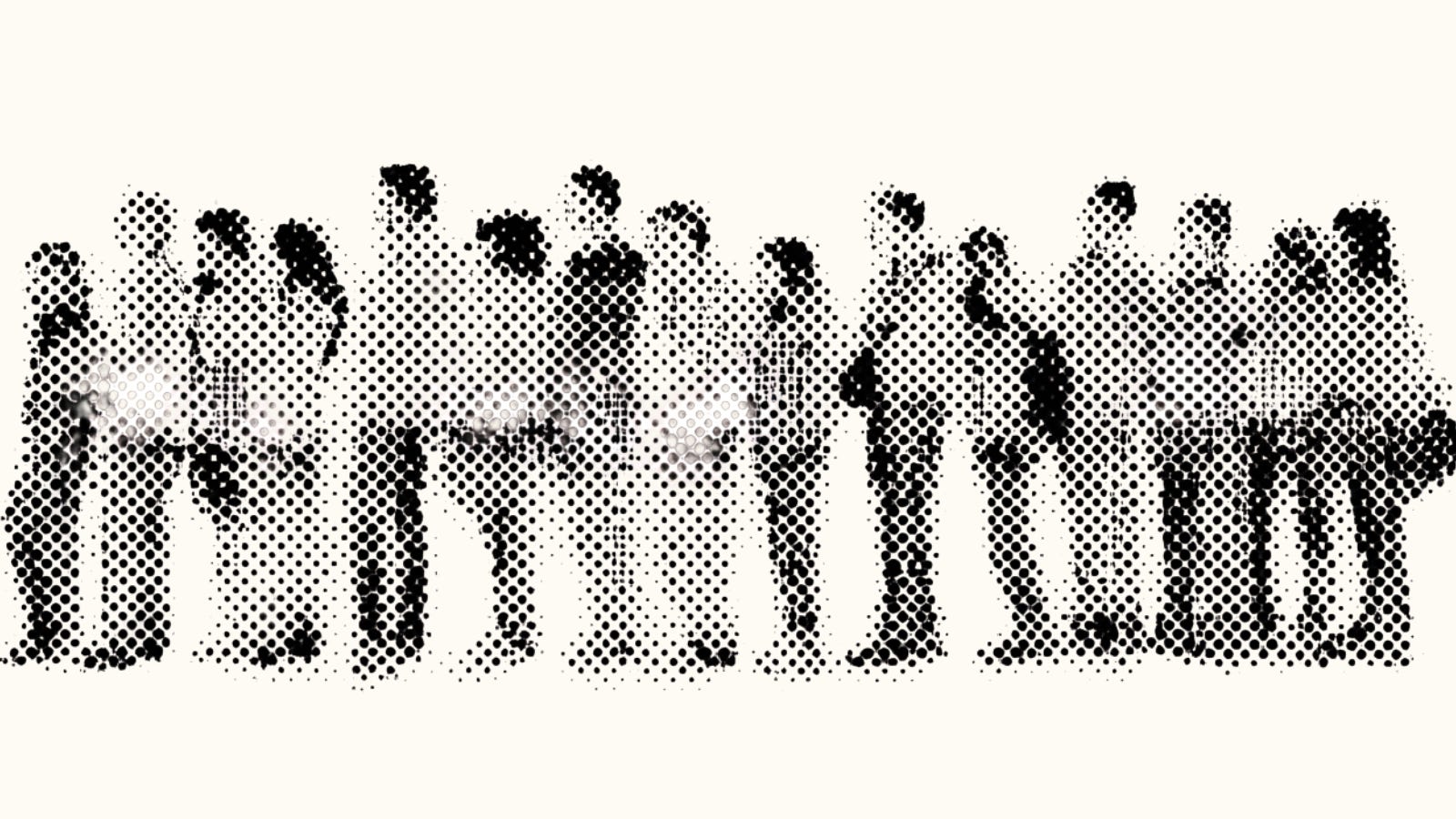
I’m not the first to note this phenomenon, but clearly, I’m not above joining the herd and being a part of something bigger than myself (like coquette scrunched pink bloomers.) Line culture is exploding with no end in sight. There’s Radio Bakery lines, dot cakes, brown butter lattes, fro-yo and more. And it’s not just food, there are pop-ups, sample sales, nightclubs and soho stores. New Yorkers are lining up to get in line! There’s even a tiktok account that uses publicly available street camera footage to send out AI-narrated reports on line length at hot spots like “Breakfast by Salt’s Cure”. Lines are meme fuel for accounts like nolita dirtbag and throwing fits. It’s an easy formula, the “so-called free thinker” jokes write themselves. Seemingly irrational lines are persisting. This is because on the personal and political level, they are serving a purpose.
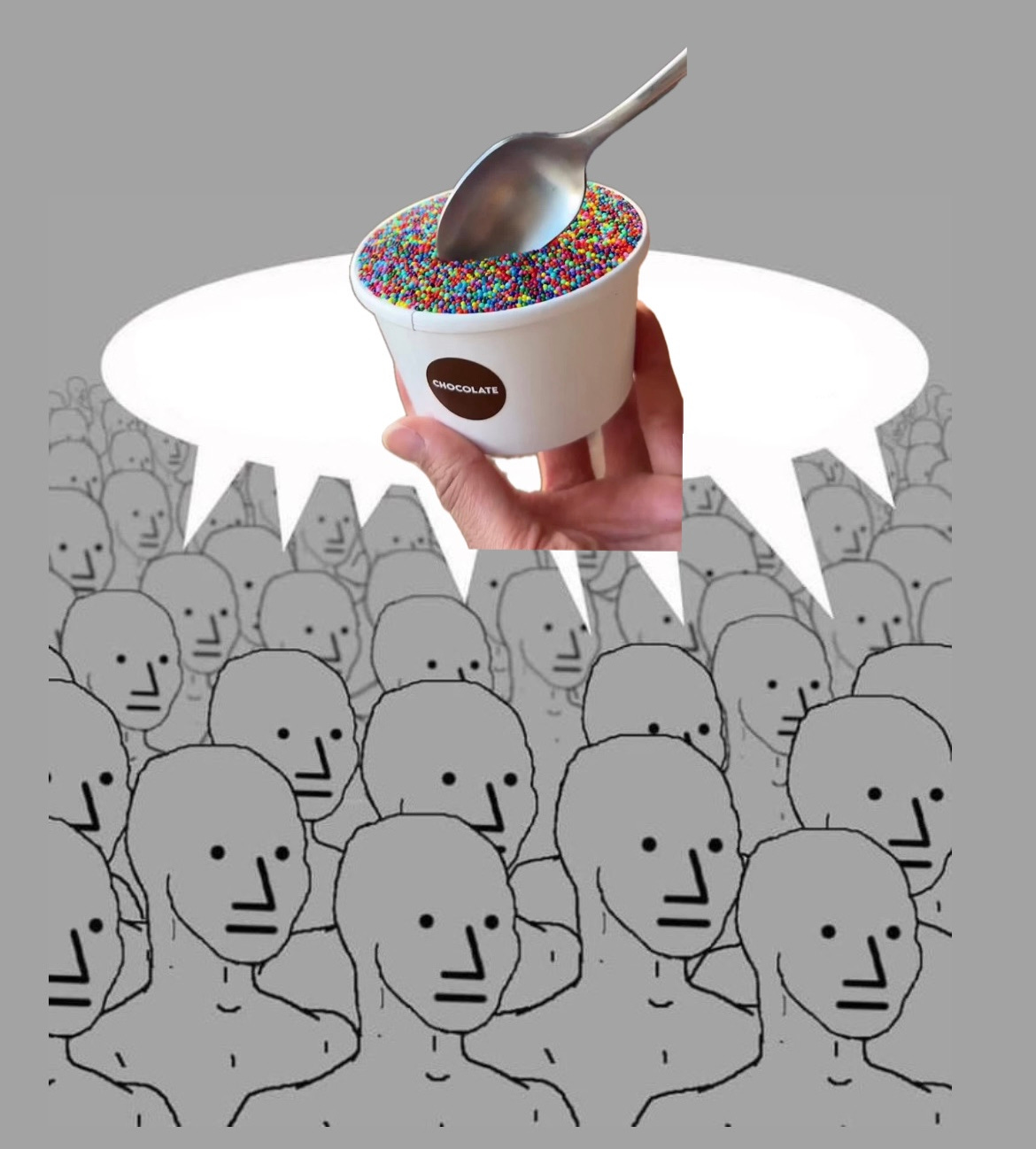
Why do we like lines?
My father, who grew up in the refugee slums of Jordan told me the first time he waited in a line was for UN flour and canned cheese. Can you believe it? This guy wants to lecture me about survival as if I didn’t literally receive sustenance from my cherry lime MiuMiu popsicle. In that context, lining up is motivated by survival. But how can a dot cake trigger this instinct?
For the fake-email-job-haver, experiencing real labor becomes a commodifiable experience. Discomfort is an attraction at the metropolitan theme park we left our frictionless suburbs for. The corporate worker class yearns to perform real labor, and they wait in line for the satisfaction of reaping something they sowed. Buying things has become too fluid via Prime two-day shipping and the desire to hunt and gather remains like an unscratched itch. There’s a reactionary desire for life to be made harder at the height of human ease. My father ashed his Marlboro and continued narrating his profound flashbacks like some kind of 7/11 Donald Draper. When he owned a car wash, he would create a line with his own cars which attracted more customers who were hoping to get in before it became even longer.
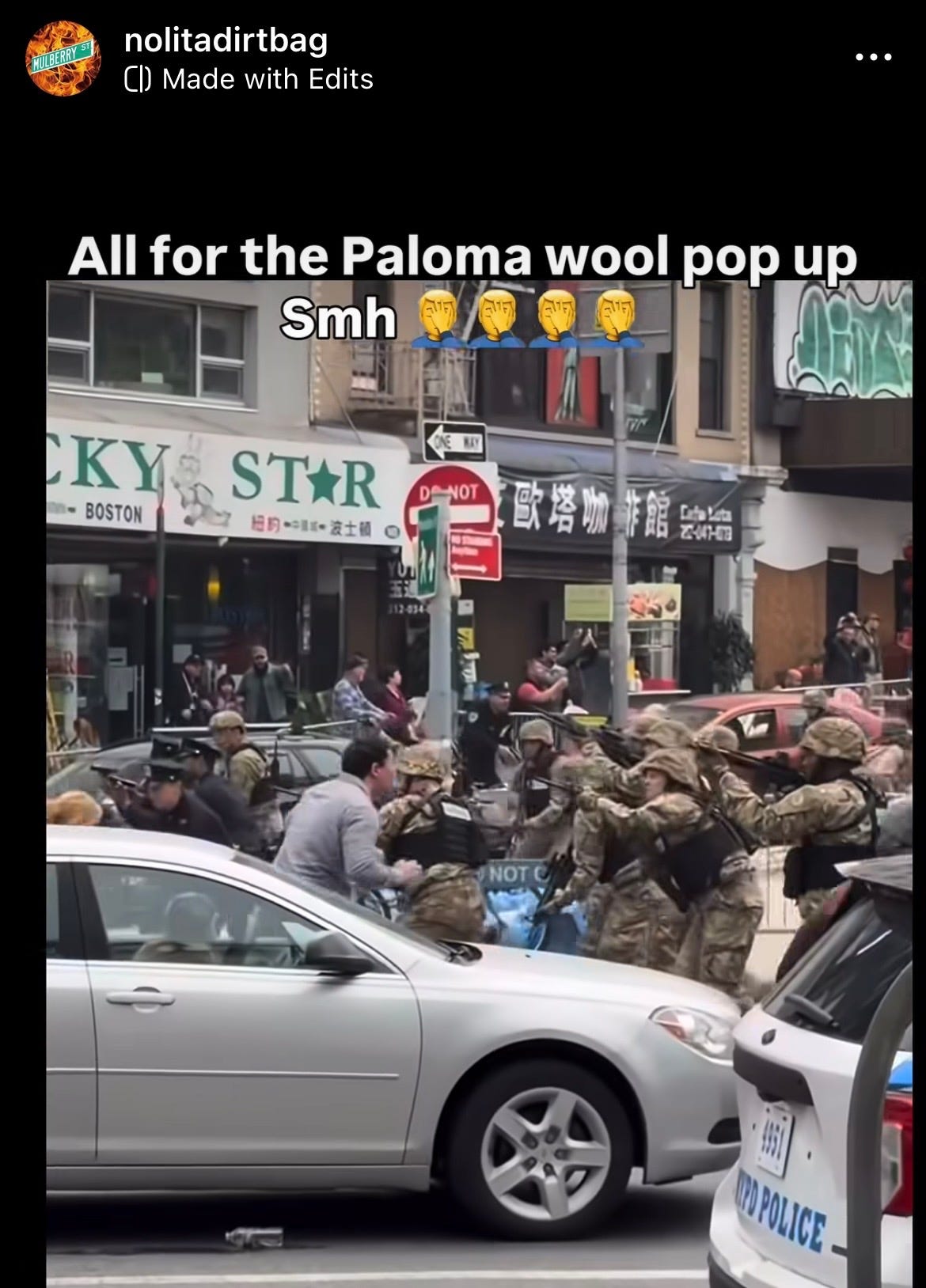
The viral line is distinct from the early 2000s Black Friday phenomenon because cost incentives are often not a decisive factor. Often these lines offer the opportunity to overpay for a deliberately understocked product. The benefit is not fiscal, it’s social. Being in the line signals that you are cultured enough to know about the product, able to afford it and you have the economic freedom to be lined up at 1pm on a Thursday. It reinforces your chosen e-dentity. “I’m not a slick back SZA With Jéan girl, I’m a Lana Bigelow hairclip Miu Miu girl”. The metaverse is based on fomo economics, and you as a cosmopolitan, can be the winner. Take that Kansas City bitches.
Being able to wait is the newest class indicator. The oversaturated influencer industry is now another tier of the working class. Short attention spans and low tolerance for boredom are now “low class”. Only posting in quarterly dumps is the mark of nobility. When exclusive things become easy to achieve, discipline becomes the status symbol. That’s why many are hypothesizing that ozempic will shift us away from the skinny standard to athletic builds. Standing in line is an ironically internet-inspired attempt to mimic having an offline life. A life where you can step away from the daily humiliation ritual of creating content, I typed substackingly.
The line is where tiktok virality goes to manifest in the physical realm. It’s proof that the world your algorithm created can come to life. Baudrillard talks about the simulation Disney creates in its parks. The park is a copy of movies which are copies of fairytales. The resulting experience has no connection to reality. The same is true of standing in a line that TikTok sent you to: the experience is based on content that’s based on a product. Baudrillard says Disney exists as a fantasy to persuade you that the rest of the world is real. Inversely the TikTok line exists to convince you that your online feed is real and that the surrounding soundstage of the world is fake. The old man staring at you filming a dance isn’t real, the usernames commenting on the post are. The sample sale is an opportunity to break the online simulation and be a part of reality. It’s a way to say “I’m here! I’m real! I exist in a physical way.”
The real dot cake was the emptiness and lack of fulfillment we had along the way.
Why do brands like lines?
As I sat holding my With Jéan booty, I recognized the distinct feel of fast fashion: wrinkle, polyester, stretch. How had they positioned themselves as a brand luxurious enough to wait for? Brands looking to increase profit margins must reduce product, increase price, or both. It’s called enshittification. If you make food products like chips, this is much more straightforward: less chips, more air.
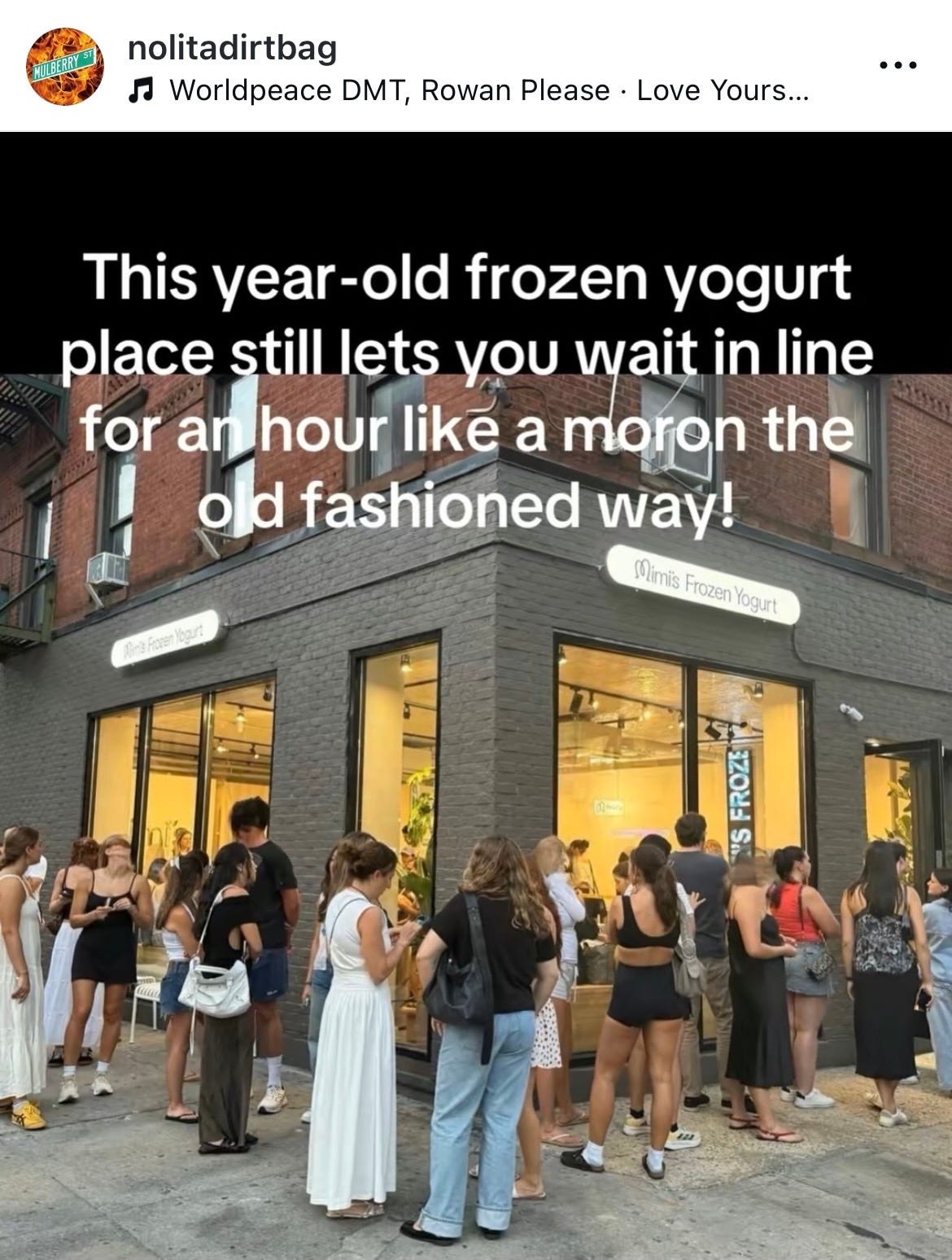
When a brand can’t skimp materials any more, they inflate market price. But they need to justify it. Lines have become a performance of manufactured popularity which is used to justify price. They force speculative value with hype and sell the emperor’s new clothes. They have no incentive to make the lines shorter or quicker–the line is the marketing strategy. Brands that cannot provide a truly satisfying product must create something else—a spectacle. The quality doesn’t speak for itself, it’s spoken into existence by thousands of “content creators”. It makes line culture the highest form of “word of mouth marketing” which is factually, the most powerful kind.
Scale as a proxy for value
In Vogue Business, Amy Francombe writes “As artificial intelligence accelerates replication, influencer culture reaches saturation, and global crisis seeps into the consumer consciousness, the industry’s reliance on scale as a proxy for value is losing traction.” There’s a capitalist tendency towards growth as a success determinant. Escalation is always the business model. But taste products have natural diminishing returns. The third slice of pizza you eat will not taste as good as the first. 100 Edikted tops will not be as beautiful as one from Prada. 1000 people in a line doesn’t make the product exceptional. But the “more is more” logic infiltrates everywhere.
In 2025, porn star Bonnie Blue went viral for what let’s call a “brand activation” where she had sex with 1000 men in one day. The emphasis on the high number of men was an attempt at scaling erotism, but volume isn’t the vector upon which “sexiness” increases. What she couldn’t amplify in allure, seduction or narrative, she provided in excess. Ragebait is measured in units of views. Line culture similarly relies on the same compensating numeral appeal. When they can’t provide quality, they roll out the sample sale and create an illusion of value with quantity. On the bright side, indie film is thriving.
Why does the system like lines?
The pandemic helped acclimate us to the rising temperature of a new enshittified status quo. It jolted us into the boiling pot of boredom, inequality, inefficiencies and chaos first with a bang, and then with a long, quiet acceptance. Waiting in long lines to receive COVID tests, and short-form content as a pastime became a new normal. The disruptive imagery of the George Floyd uprising and pro-Palestine activism of that time poses a problem for the ruling class: it inspires. The “system” naturally understands that excess thinking time leads to social entropy.
The culture of lines does the opposite: it tames. It’s communion without disruption. The line is straight. The line is orderly. The line never asks for more than a retail experience–which [insert company] is happy to provide for a fee. The line doesn’t question itself. The line doesn’t damage property. The line doesn’t withhold worker productivity. The line doesn’t step out of line. It’s the opposite of a strike or boycott. It’s a celebration of capitalism and an opportunity to reward it. The line stays straight and on the sidewalks. Lines are the symbolic antidote to the uprising and rebellion problem. It’s a model of compliance. You are only a citizen when you consume.
If you’ve ever been to a pro-Palestine rally in NYC, you’ll notice Hasidic jews as a fixture of these events. They attend to help dispel conflations of Judaism and Zionism. But juxtaposed to the rest of the scattered crowd they do something unique: they stand in one long line, holding rope to stay connected. Perhaps it is some subconscious understanding that this will protect them from accusations of disorderliness. Perhaps they are instinctively forming an extreme example of decorum, hoping to point out the contradiction of their behavior and the media’s image of the rowdy rioter. Maybe it’s one of those well-meaning attempts to become a perfect-enough narrator to deserve being heard, as Mohammad El Kurd writes about. Or maybe they just don’t want to lose each other in the crowd.
The end of the line
I sold my With Jéan haul for double the price on depop in the end. I imagine the sharks from the Shark Tank dabbing their eyes and slow-clapping at my entrepreneurial spirit. “I’d like to give you $80 for a 100% stake in that cunty blush rosette halter top!” I imagine Kevin O’Leary saying.
Line culture seems to suggest an excess of manpower being directed into a frivolous activity with an incoherent ideology of product worship. It’s easy to roll eyes at line culture, but I prefer to have an imaginative outlook on this curiosity. There is a potential energy in the masses. I like to think about where else it could be channeled, and how to convince each other to redirect it.